
You step onto a ladder to clear the gutters, or a roofer walks the slope after a storm, and one patch of shingles gives a little underfoot. That give is a soft spot, and soft spots on a roof almost always trace back to the wood deck under the shingles rather than the shingles themselves. The question most Cleburne homeowners ask next is simple: is this an emergency, or can it wait?
The honest answer depends on what is soft, why it got that way and how far the damage reaches past the spot you can feel. This guide walks through what makes a roof deck go spongy, how the edges of the damage get found, which signs mean act now, and what the repair actually involves on a Johnson County house.
A Soft Spot on a Roof Means the Deck Has Lost Stiffness
A soft spot is an area where the roof deck, the plywood, OSB or older board sheathing nailed across the rafters, flexes more than it should under weight. The shingles are only a weather skin. They have almost no stiffness of their own, so when a section feels spongy, the give is coming from the layer beneath them.
Rot is the most common cause, but it is not the only one. A sheet that was installed without edge support between rafters can bounce along its seams. OSB that soaked up water during a reroof can swell and stay weak along the edges. Each of these feels similar from the top and each calls for a different fix, which is why the cause matters more than the sensation.
Roof Decking Only Rots When It Stays Wet
Wood decay is a fungal process, and those fungi need water in the wood itself to grow. A review of decay thresholds by researchers at the USDA Forest Products Laboratory, Limiting Conditions for Decay in Wood Systems, puts it plainly: wood will decay above 30 percent moisture content and will not decay below 20 percent, with the range between treated as a grey area. Kiln-dried sheathing goes onto a roof well below that line. Something has to keep pushing water into it.
On Cleburne roofs, that something is usually slow and hidden rather than dramatic. A split pipe boot, step flashing pulled loose at a sidewall, failed chimney counterflashing, a skylight curb, or a bath fan venting into the attic instead of through the roof. None of these has to drip onto a ceiling to keep a patch of decking damp for months.
The same paper notes that decay is harder to stop than to prevent, because the fungi produce water as they break down the wood. Once a section is actively rotting, it can keep itself wetter than its surroundings, which is one reason soft areas tend to spread outward from the original leak point rather than staying put. With the National Weather Service listing a 1991 to 2020 normal of 37.01 inches of annual rain at DFW, the nearest long-record station, North Texas roofs get enough water for a small flashing gap to matter.
Decking Loses Strength Long Before It Looks Rotten
Decay weakens wood far faster than it changes the way wood looks. A Virginia Tech wood science article, Detecting Early Wood Decay, reports that wood can lose as much as 70 percent of its strength after only a 3 percent loss in weight to decay fungi, and that damage at that stage is difficult to see without a microscope. Toughness, the ability to absorb a sudden load, is the first property to go.
Two things follow. The soft area you can feel underfoot is usually the worst of it, not all of it. Wood around it that still looks fine and still holds a nail may already be weaker than it should be. And impact is what a weakened deck handles worst, so anyone on a roof with suspected rot should stay off the spongy zone until it has been checked from below.
Three Questions Decide Whether It Is an Emergency
Most soft spots are not emergencies. Three questions sort the ones that are.
Is water getting in right now?
A soft spot with an active leak beneath it, a fresh or growing ceiling stain, wet insulation or drips during rain, is time-sensitive. Every storm adds moisture to wood that is already above the decay threshold. That situation belongs with roof leak repair first, with the decking dealt with as part of the fix.
Can you see it from the ground?
A sag visible from the street or yard, a dip between rafters or a wavy line across the shingles, means a section has deflected enough to show. That is a structural sign, not a cosmetic one, and it should not wait for the next convenient month.
Can you see daylight or broken wood from the attic?
Light coming through the deck, a panel that has cracked through, or fasteners that have pulled free mean the decking is close to failure at that spot. Stay off that section of the roof entirely.
Finding the Edges of the Damage Takes Two Views
The edges of deck rot are found from the attic first and the roof surface second. From above, a roofer can feel the give and read the shingle line, but only the underside shows how far the moisture has travelled.
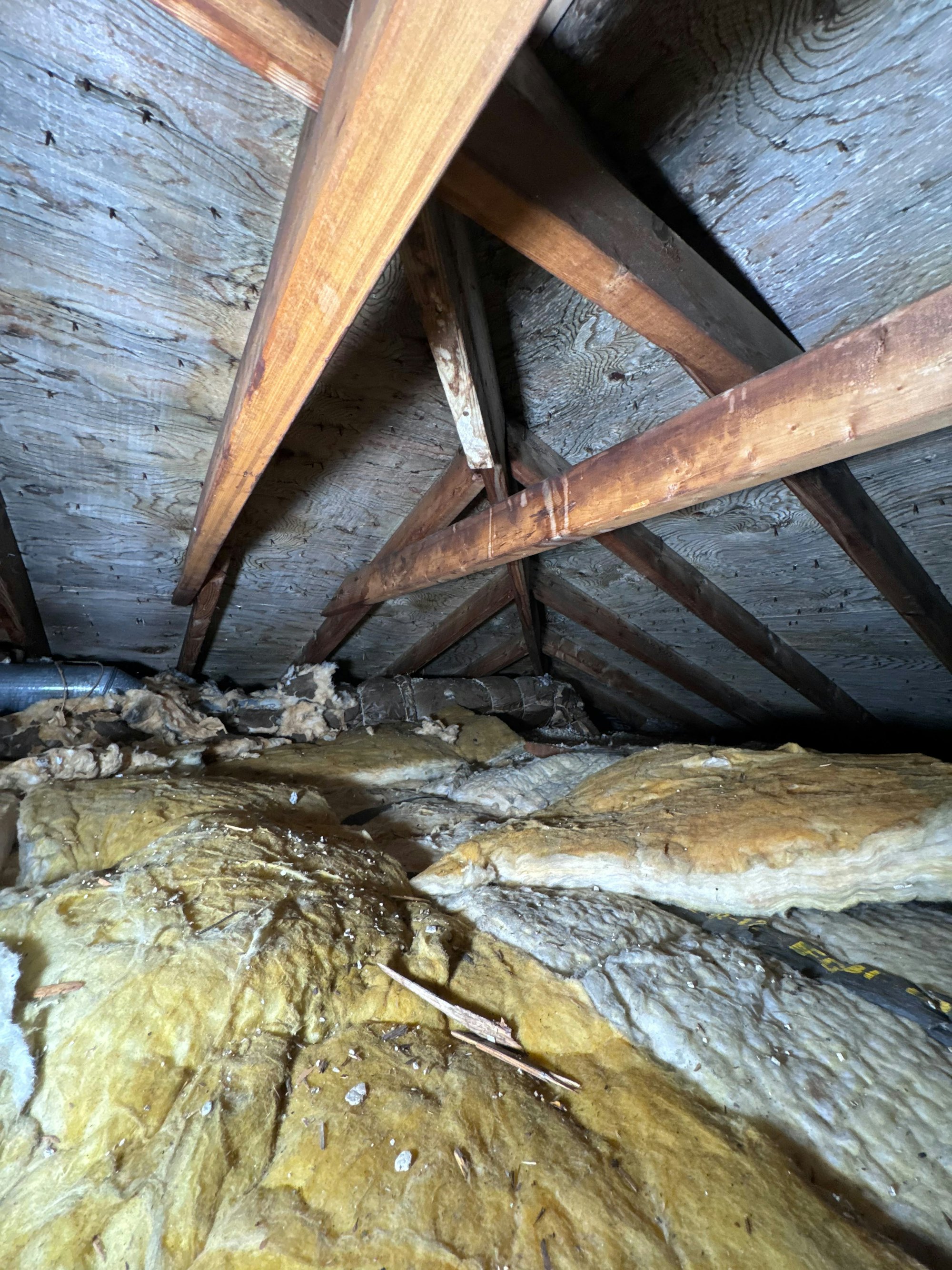
In the attic, look for dark staining on the sheathing around nails and seams, white or brown fungal growth, plywood plies separating, OSB that has swollen and lost its crisp edges, and rusted nail tips poking through. Water runs downslope along the underside of the deck and along rafters before it drips, so the stain on the ceiling below can sit several feet from the spot that let water in.
Probing confirms what the eye suggests. The Virginia Tech article describes a pick test: an ice pick or awl pressed into wood known to be sound for comparison, then into the suspect area. Sound wood is dense enough that the pick goes in with difficulty, while decayed wood fails in a brash, brittle break directly over the tool, often with barely any sound. A roofer probing in a ring around the soft spot can mark where sound wood begins, which is where the repair boundary goes. A roof inspection that includes the attic is the cleanest way to get that boundary on paper.
The Repair Scope Follows the Water, Not the Soft Spot
A deck repair is only finished when the moisture source is fixed along with the wood. Replacing a rotten panel under a pipe boot that still leaks buys a few years at most, so the scope always starts with where the water came from.
The typical sequence is to strip shingles and underlayment around the damaged area, cut out decking back to sound wood, extend the cut so new panel edges land on rafter centers, check the rafters themselves for decay, then fasten new sheathing of matching thickness so the surface stays flat. On older Cleburne homes with board decking instead of plywood, matching thickness can take shimming or furring so the patch does not leave a visible step.
Scope changes when the soft areas multiply. A single spot below a failed boot is a roof repair. Several soft areas across different slopes, a roof already near the end of its shingle life, or rot discovered at multiple penetrations points toward full decking review during a reroof, and our repair versus replacement guide covers how age and spread of damage settle that call. Either way, the attic ventilation and exhaust fan routing get checked, because a deck that rotted from the underside will rot again if the moist air stays.
Before You Call: Short Answers on Spongy Roof Decking
Can I just put new shingles over a soft spot?
No. Shingles do not add stiffness, and fastening new roofing into decayed wood gives nails nothing to hold. The rotten section has to be cut out and replaced with new sheathing before any roofing goes back on.
How big does a soft spot get before the roof fails?
There is no fixed size. Failure depends on how far decay has spread, the span between rafters and the load put on it. Because strength drops long before wood looks bad, a small spot can be weaker than it seems, so treat any growing soft area as a reason to schedule an inspection rather than a countdown.
Will a soft spot dry out and firm up on its own?
Wood that has decayed does not regain strength when it dries. If the moisture source is fixed before decay sets in, the wood can stay sound, but once fungi have broken down the fibers that loss is permanent and the section needs replacing.
Does a soft spot always mean the whole roof needs replacing?
Usually not. Most soft spots trace to one leak point and are handled as a section repair. Replacement comes into the conversation when soft areas show up in several places or the shingles are already near the end of their service life. Cleburne Roofing Pros can talk that through once the attic and roof have both been checked.
Not Sure How Far the Rot Goes?
A check from the roof and the attic, with the soft area probed and its edges marked, turns a spongy feeling underfoot into a written repair boundary.
Research Behind This Guide
- Morris, P. I. and Winandy, J. E., USDA Forest Products Laboratory, Limiting Conditions for Decay in Wood Systems
- Anderson, C. A., Loferski, J. R. and Woeste, F. E., Virginia Tech, Wood Bits: Detecting Early Wood Decay
- National Weather Service Fort Worth, 1991-2020 Climate Normals for DFW and Waco