
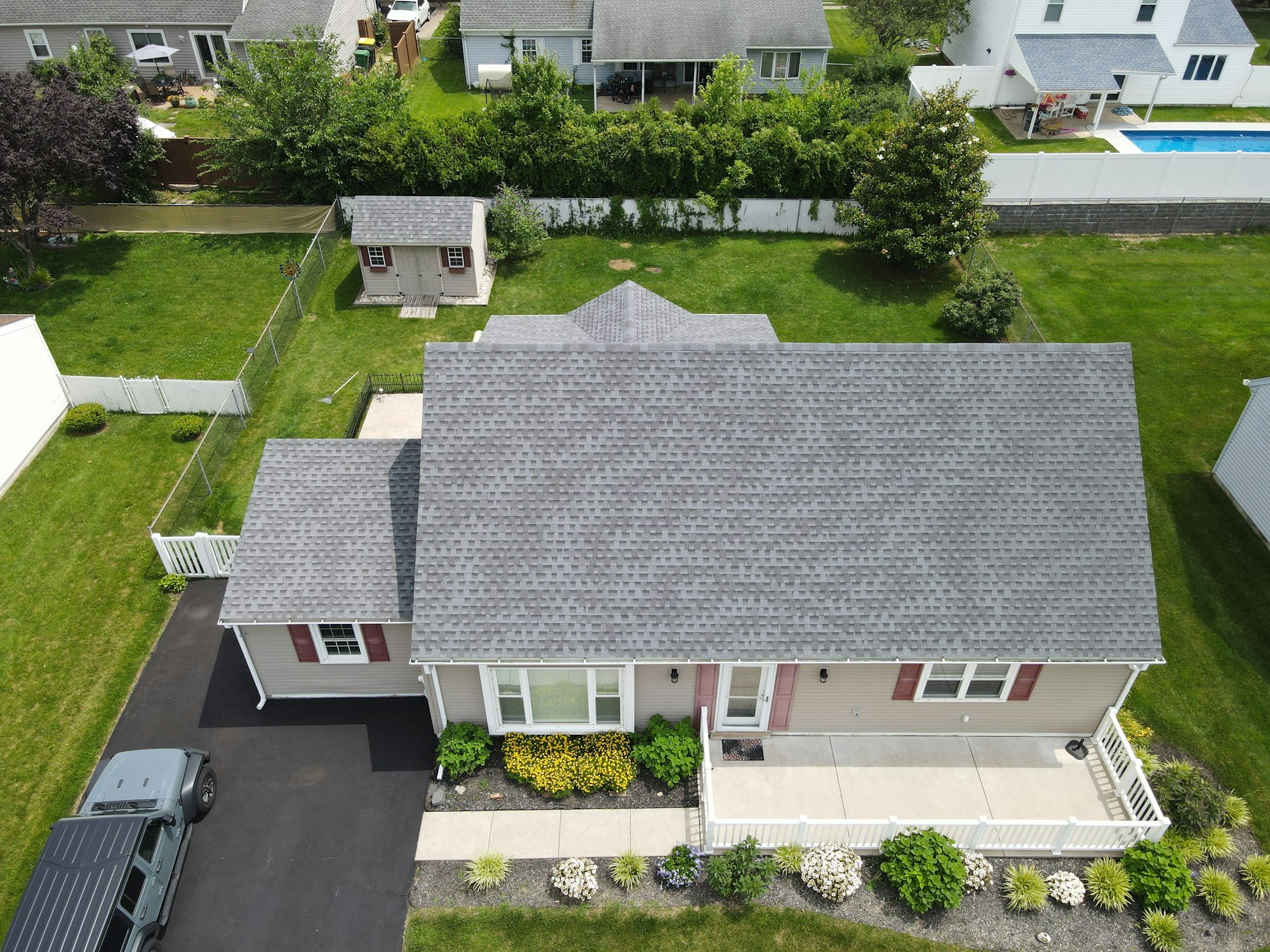
Why does the ceiling stain always show up in the same corner, right below the spot where two slopes of the roof meet? On a lot of Cleburne houses the answer is the valley. Roof valley leaks tend to announce themselves in the hardest storms of the year, because the valley is the one place on a shingle roof where water from two planes is forced into a single narrow channel, and any weakness in how that channel was built gets tested every time it rains.
Below: the three valley styles you will find on homes in Cleburne, Joshua, Keene and Burleson, why leaves and granules make things worse, how a valley leak shows up indoors, and what a proper repair involves.
Why does a roof valley carry more water than any other part of the roof?
A valley is the inside angle where two roof slopes meet, and it carries more water than any other line on the roof because it drains both of those slopes at once. Every square foot of shingle on either side sheds toward it, so a valley at the bottom of two long slopes can carry a stream rather than a film of water during a downpour. The Fine Homebuilding guide to shingling valleys puts it simply: valleys collect and channel a greater volume of water than a single roof plane.
The IKO guide to watertight shingle valleys calls the valley one of the most critical details on the roof and warns that an improper one can cause serious leaks. Fast water off one slope can also carry across the centerline and push up under the shingles on the far side, which inspectors call cross-wash.
What are the three common valley types on a shingle roof?
Most shingle roofs use one of three valley styles: open metal, closed-cut or woven. All three sit on a waterproof lining; what differs is what the water runs over on the surface, and that changes how each one fails.
Open (metal) valley
In an open valley the shingles on both sides stop short of the centerline and the water runs down an exposed strip of metal. InterNACHI's inspection guide to valley construction defines open valleys as those where the roofing stops several inches short of the centerline, with a lining that is usually metal. Fine Homebuilding describes a liner 2 to 3 feet wide with at least 3 inches of metal left showing in the middle, and warns that nailing through the metal must be avoided.
Closed-cut valley
In a closed-cut valley the shingles from one slope run through the valley onto the other, and the second slope's shingles are laid over them and trimmed a couple of inches short of the center. InterNACHI notes cut valleys are the most common and less expensive closed style; Fine Homebuilding adds that the cut edge must be sealed and nails kept at least 6 inches from the centerline.
Woven valley
In a woven valley the shingles from both slopes overlap alternately across the valley, so no cutting is needed. Fine Homebuilding rates it the most wind-resistant method, but hollows under the weave can be punctured. The catch is shingle type: IKO states that laminated shingles are too thick to be woven well and that it does not recommend a woven valley with them.
The three valley styles side by side
- Open metal: water runs on exposed metal; durable when installed properly; weak points are nails too close to the metal and poorly sealed shingle edges.
- Closed-cut: water runs over the first slope's shingles; fast and clean-looking; weak points are a cut line too near the center, unclipped corners and nails near the centerline.
- Woven: water runs over interlaced shingles; wind-resistant on paper; weak points are bulges and hollows, and it suits thin shingles rather than thick architectural ones.
Which valley style holds up best on a North Texas roof?
No single style wins everywhere; the right valley is the one that suits the shingle on the roof and is installed to the manufacturer's instructions. Most valley leaks are installation details rather than design flaws: a well-cut closed valley can outlast a sloppy open one.
With the laminated shingles common today, the realistic options are closed-cut or open metal; InterNACHI notes heavy laminates may crack in a woven valley and that weaving should not be used below a 4:12 slope. IKO says a properly installed open valley holds up better over time and drains more readily, a fair reason to consider metal on a low valley that catches leaves. On a replacement, ask about the valley method by name.
How do debris and shingle granules turn a valley into a dam?
Debris turns a valley into a dam by slowing the water and pushing it sideways, out of the channel and under the shingle edges. When leaves and twigs collect at the foot of the valley or where it meets the gutter, water backs up, spreads wider than the channel and reaches cut edges and nail lines never meant to sit in standing water.
Shingle granules add to the problem in a less obvious way. As asphalt shingles age, loose granules wash down every slope, and the valley is where both slopes deliver theirs. A drift of grit in the gutter below a valley means the shingles above are shedding, and that grit can help hold leaf litter in place. IKO notes open valleys reduce the risk of debris blockages on lower-slope roofs. On any style, keeping the valley and its gutter clear is the cheapest leak prevention there is; binoculars from the yard usually show whether a valley is buried.
What do roof valley leaks look like from inside the house?
A valley leak usually shows up as a stain or drip on the ceiling or wall below the point where two roof slopes meet, often near an inside corner of the house or above a bay or dormer. The stain does not always sit directly under the valley, because water that gets under a shingle can run along the decking or the top of a rafter for several feet before it drops. Fine Homebuilding notes that clipping the upper corner of each cut valley shingle keeps water in the valley instead of letting it leak several feet away.
Timing is the other clue. The roof leak repair page on this site notes that leaks appearing only in heavy or wind-driven rain are usually flashing or valley issues. In the attic, a flashlight along the underside of the sheathing at the valley line can show dark staining or rusted nail tips; InterNACHI tells inspectors to check that underside on older homes.
Is it the valley, or something nearby?
Not every leak near a valley comes from the valley, so the source has to be traced first. Valleys often run into walls, dormers and chimneys whose flashing can fail on its own, and a vent near the valley line can send water into the same part of the attic.
Some are not roof leaks at all: the same page lists attic condensation and an overflowing HVAC drain pan as look-alikes, and plenty of North Texas homes keep the air handler in the attic. The right sequence is to note where and when water appears inside, trace it in the attic, then inspect the roof from that spot.
How is a leaking valley repaired?
A leaking valley is repaired by fixing the specific failure, from resealing a few shingles to rebuilding the valley down to the deck. The scope depends on what the trace finds, the roof's age and whether the decking is damaged.
- Clearing and resealing: removing debris, resealing lifted cut edges and replacing cracked shingles.
- Correcting the cut: re-cutting shingles trimmed too close to the center and moving nails away from the centerline.
- Rebuilding the valley: stripping both sides, replacing soft decking, relining and reinstalling.
- Temporary protection: for an active leak, a tarp can hold until a permanent repair is done, since the leak repair page notes permanent repairs require a dry roof.
On an old roof with worn shingles on both sides, a valley rebuild may only buy a few years, which moves the conversation toward broader roof repair or replacement.
Where to Look First When a Valley Drips
Start with timing and position: does the stain grow only in hard, wind-driven rain, and does it sit below an inside corner where two slopes meet? Then look at the valley from the ground for leaves, a drift of granules, an overflowing gutter at that corner or lifted shingle edges. If the attic is accessible, a flashlight along the valley line tells you more than the ceiling does.
What settles the repair is the cause, not the symptom. A blocked valley needs clearing, a badly cut one needs correcting, and a valley with wet decking under it needs rebuilding. If a stain keeps returning below a valley, roof leak repair from Cleburne Roofing Pros begins with that trace and written findings, so the fix matches what the valley is actually doing.
Stain Below a Valley That Keeps Coming Back?
A leak trace follows the water from the ceiling to the attic to the roof, and you get written findings with photos showing whether the valley, nearby flashing or something else is letting it in.